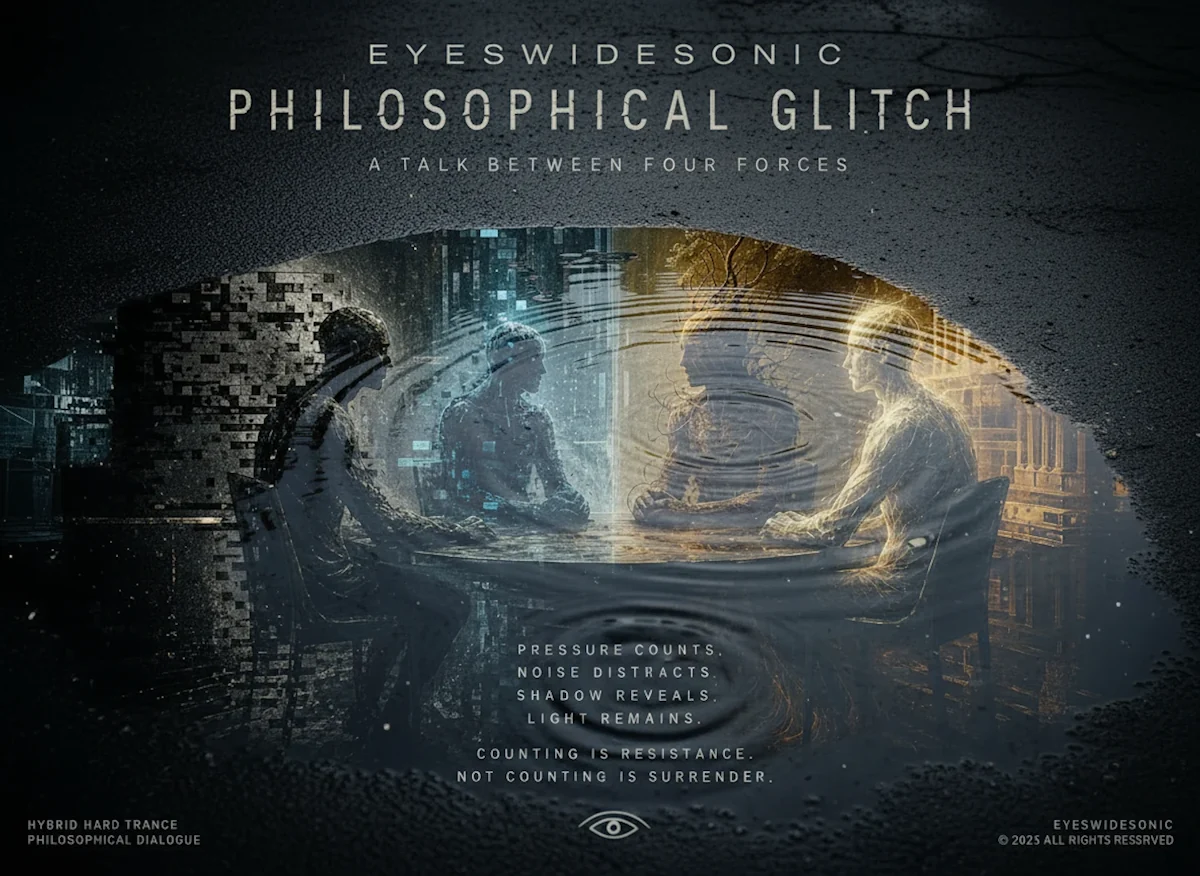
THE PHILOSOPHICAL GLITCH
The Conceptual Framework of EyeswideSonic
The Philosophical Glitch forms the intellectual backbone of EyeswideSonic. It is a self‑contained system in which texts and sonic structures become contemporary responses to some of the oldest questions of human existence. Philosophy unfolds here through dialogue rather than distance, shaped by four distinct lines of thought.
The Four Pillars of Reflection
Tracks like We Kept the WiFi draw on Heidegger’s idea of Gerede. They reflect the continuous digital murmur in which being dissolves into noise and presence turns into simple availability.
Achiever Blues and The Quiet Grift move closer to Schopenhauer. Both pieces trace the quiet suffering woven into the mechanical loop of self‑optimization. They take the form of sonic diagrams of a culture that confuses movement with purpose.
The search for the self leads to C. G. Jung. Whispers of Freedom and Rituals of Madness open spaces of individuation. They illuminate the shadows behind our digital masks and call for the integration of hidden fragments.
As a counterforce to total acceleration, Aristotle enters the scene. Gentle Silence creates a field of intentional quiet, scholé, where a meaningful life can begin to take shape.
The Glitch as Event
Within this framework, the glitch does not appear as a failure. It emerges as a conscious interruption in the digital continuum, a moment of stillness in which the system seems to hold its breath. In this pause, the philosophical traditions start to communicate with one another, and sound becomes the medium of their exchange.
A Unique Philosophical Contribution
Lines such as “Counting is resistance. Not counting is surrender.” go far beyond lyrical fragments. They express an independent stance toward the logic of the data age and outline a new form of agency in a world that constantly measures and compares.
Images like “Little lies in neat rows” condense complex systemic relations into clear and poetic formulations. This precision is something Schopenhauer would have immediately recognized.
The Bridge to Opera Nova
In this system, the philosophers do not describe the world from the outside. They open the cosmos of EyeswideSonic itself. This creates a self‑referential cycle in which the work becomes both the object and the method of inquiry.
In this way, the path toward Opera Nova takes shape. It becomes a work that no longer comments on reality but establishes its own philosophical architecture, equipped with its own logic, its own ethical principles, and its own sonic language.